You don't need to memorise hundreds of prompts. You need to learn how to create, test and improve the right instruction. ASKTURA: The Universal Guide to Mastering AI Communication gives you one method that works with any AI — for text, research, images, video, code and agents.
One method for text assistants, research tools, workplace copilots, image and video generators, voice tools, coding assistants, data work and AI agents.
The five-minute AI wake-up
Most people send AI a topic. Professionals send it a task.
Same request, three levels. Watch what changes: not more words, but the audience, resources, target, decision criteria and the shape of a good answer.
“Marketing ideas.”
What the AI knows
Who it's for
Goal
Budget
Deliverable
Criteria
Limits
A topic, not a task. Expect a generic list that could apply to any business on earth.
“Give me five inexpensive marketing ideas for a new barber shop. The customers are university students. Explain the cost and the first action for each idea.”
What the AI knows
Who it's for
Deliverable
Cost & first action
Target
Budget
Criteria
Honesty limits
Now there's an audience and a shape. Still no target to aim at and no way to rank the ideas.
“Act as a practical marketing planner. Help a new barber shop near a university attract 30 first-time customers in 30 days on a budget of R3,000. Give me five options, estimate costs as assumptions, rank them by ease and likely impact, then build a one-week test for the top two. Ask for a missing fact only if it changes the plan. Do not present estimates as research.”
What the AI knows
Perspective
Target
Deadline
Budget
Deliverable
Ranking criteria
Next step
Honesty limits
A useful plan is imaginable before the AI even replies. That's the whole game.
Chapter 01 · the core method
The PROMPT Loop: six moves, one reusable method
Not a rigid script — a mental checklist for a casual question, a serious business task or an automated workflow. A simple request may need only Purpose and Output. Add the rest as the stakes rise.
P
Purpose
Name the outcome, not the topic. “What will I have when this is finished?”
R
Relevant context
Supply the facts that matter — selectively. More sensitive data isn't better data.
O
Output
Describe the deliverable: a 200-word email, a decision table, valid JSON, a storyboard.
M
Must-haves
Make the boundaries visible. A useful constraint is testable; “make it amazing” is not.
P
Proof
Say how the result will be checked: sources, formulas, tests, risks, acceptance criteria.
T
Tune
Don't just say “better”. Diagnose what failed, keep what worked, fix one thing.
When an AI disappoints you, resist the urge to write a giant new prompt. Diagnose before you rewrite. Pick what went wrong and get a targeted SEE → FIX → TEST repair you can paste straight back in.
Your repair
Pick a symptom
Choose one of the seven failure modes on the left. You'll get the diagnosis, a three-step repair and a copy-ready prompt that fixes only what failed — and keeps what was already right.
The goal stays constant. The instruction language changes with the medium. Type one mission and see it written in the grammar each kind of AI actually needs.
Try:
Portability check before you paste: can this tool access the material? Does it support the medium? Is browsing current and enabled? Can it run code? Are privacy and permission settings right? If any answer is no, adapt the workflow — don't insist on the prompt.
Chapter 02
Fifteen ways to prompt. Choose the one that fits the job.
Families of practice, not a dictionary of jargon. Pick what you're trying to do and the methods that fit light up.
I want to:
01
Direct
Just ask for the thing. Best for simple, low-ambiguity tasks.
02
Role
Set a useful perspective and standard. Roles don't grant real qualifications.
03
Context-rich
Make hidden facts visible so the AI designs within real constraints.
04
Example-based
Show two or three examples when the pattern is hard to describe.
05
Conversational
Build through dialogue: draft, feedback, revise. Say what must stay.
06
Stepwise
Divide big work into stages, each confirmed before the next.
07
Comparative
Choose between options with explicit criteria, trade-offs and unknowns.
08
Critique
Ask for the strongest objections, then demand repairs, not complaints.
09
Source-grounded
Tie every claim to supplied evidence, and say “not specified” when it's silent.
10
Structured output
Design the shape: tables, CSV columns, JSON schemas. Then validate.
11
Visual
Describe what the camera sees: subject, composition, light, material, mood.
12
Audio & video
Direct time and performance: pace, emotion, shot order, continuity.
13
Coding & data
Specify behaviour, interfaces, missing-data rules and tests.
14
Research
Ask for competing explanations, recency and what would change the conclusion.
15
Agent & workflow
Govern actions: goal, allowed and banned actions, checkpoints, stop condition.
SPECIALIST
Constraint-first
State non-negotiables before the task when failure is expensive.
SPECIALIST
Counterexample
Show a wrong example and why it's wrong to sharpen the boundary.
SPECIALIST
Retrieval-grounded
Answer from retrieved material with traceable references (RAG).
SPECIALIST
Evaluation-driven
Write test cases first; keep a prompt only if it wins across all of them.
The prompt diet: if the issue is missing data, gather data. If the job needs arithmetic, use a spreadsheet. If it needs current facts, use an authorised source. Longer instructions do not replace missing capabilities.
Chapter 05 · the professional workflow
From a clever answer to repeatable results
A professional doesn't stop when an answer sounds persuasive. Five gates take any AI task from a request to something a named person can stand behind.
Define
Objective, audience, boundaries and acceptance criteria. What decision will this support?
Ground
The right files, extracts and current information. Facts separated from assumptions.
Produce
The right tool and technique. Build the artifact, not a description of it.
Verify
Claims, citations, calculations, tests, security and accessibility — checked.
Approve
A named human approves sending, publishing, spending or deploying. AI never does.
STOP
Sensitive informationUnsure whether a document may be submitted? Get authorisation or use an approved environment.
STOP
Evidence gapA number or source you can't substantiate is marked unverified — never presented as fact.
Before you trust an AI output, score it. Five dimensions, 0 to 2 each, on a real prompt and the answer it produced. A perfect ten never overrides a critical failure.
Your score
0/10
0 of 5 scored
Score all five dimensions against a real prompt and its output.
Designed to be used, not admired
Twelve challenges. Something to show, not just remember.
Every chapter ends with a hands-on challenge and a pass condition. The full briefs are in the book; track your progress here.
Inside the book
Eight chapters. Three missions. Read it in an evening, use it for years.
The contents as a trail: the wake-up at base camp, the toolkit near the top, and the bonus missions at the summit. Each chapter links to the part of this page that lets you try it.
Stop asking vaguely, start directing deliberately. The four truths that change everything and the thirty-second upgrade.
Six tear-out cards — the universal builder, five rescue prompts, the decision, source-check and agent-boundary prompts, a version log — and the ten golden habits.
Three complete show-don't-tell demonstrations: a one-person business launch, a school information assistant and an executive decision brief. Plus the challenges at a glance, a 90-minute facilitator run sheet, a jargon-free glossary, official learning links, the Quality Scorecard and a corporate course kit.
Anyone who has stared at a blank chat box, unsure where to begin
Complete beginners
No technical background needed. One AI tool, one real problem and ninety minutes to learn the core method.
Professionals & managers
Briefs, reports and decisions that are grounded, checked and owned — not just fluent.
Entrepreneurs
Validate ideas, plan launches and draft offers without inventing demand, prices or facts.
Educators & trainers
Twelve challenges, a scorecard and a ready-made 90-minute run sheet for teaching AI literacy.
Creators
Visual briefs, shot lists and voice direction that get you what you pictured, not what the model guessed.
Teams adopting AI
A shared method, five gates and three stop signs so AI work is safe, reviewable and repeatable.
Lines worth sharing
Truth outranks fluency
ASKTURAP · R · O · M · P · TSEE → FIX → TEST5 rescue prompts10 golden habits
Free · one-page reference
Get the ASKTURA Pocket Toolkit
The PROMPT Loop, the SEE → FIX → TEST repair, five rescue prompts, the ten golden habits and the universal builder on one printable page. Join the launch list for the PDF and reader-only updates.
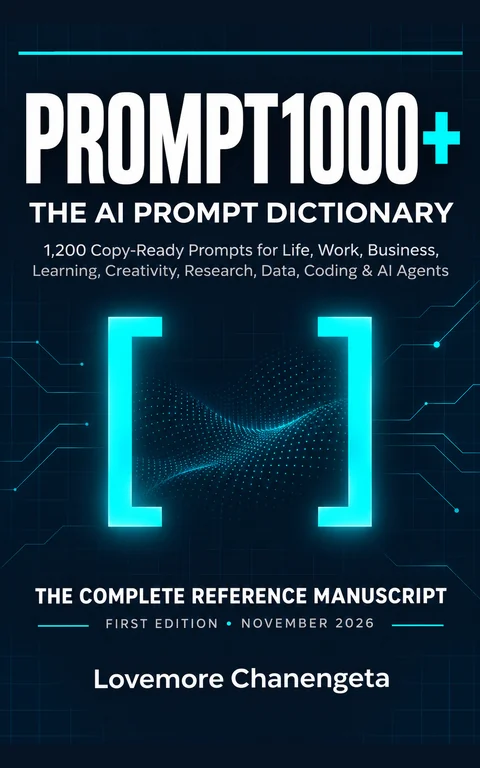
ASKTURA teaches you to create, test and improve your own instructions for any AI. PROMPT1000+ gives you 1,200 ready-made prompts for 240 real tasks, built on the same PROMPT formula. One builds the skill; the other gives you a head start every time you sit down to work.
Technology entrepreneur and systems builder. Founder of LVMRE and CTO of eduSYMS, with two decades spent putting technology to work inside real institutions. He wrote ASKTURA for everyone who has ever stared at a blank chat box, unsure where to begin — because the world doesn't need more people who can paste impressive commands. It needs people who can define meaningful problems, communicate clearly, test what they receive and turn ideas into responsible action.
“ASKTURA is not a collection of magic words. It is a discipline of useful questions and responsible results.”
ASKTURA Essentials: master AI communication in 90 minutes
The book was built to be taught. Every learner leaves with evidence — a baseline prompt, a full PROMPT Loop, a verified deliverable and an improvement log — not just attendance.
Keynote
“The Prompt Is Not the Product” — why the useful, verified outcome is what counts, and how to get it from any AI.
90-minute workshop
Facilitated, hands-on and built on your team's real work: PROMPT Loop, repair lab, five-gate workflow and a scored capstone.
Course kit & bulk copies
Pocket copies for every learner plus the 12-challenge workbook and facilitator guide to run it in-house.
The 100-point rubric is an internal course standard, not an accredited qualification.
A compact, practical guide to communicating with any AI. It teaches one reusable method: describe a goal, choose a suitable tool, provide the right context, inspect the result and improve it. Inside: the six-move PROMPT Loop, fifteen prompting methods, the Prompt Repair Lab, a five-gate workflow, three worked missions and twelve hands-on challenges.
How is it different from PROMPT1000+?
ASKTURA teaches the method — how to create, test and improve your own instructions. PROMPT1000+ is a dictionary of 1,200 ready-made prompts built on the same PROMPT formula. Start with ASKTURA to build the skill; keep PROMPT1000+ on the desk for a head start on specific tasks.
Which AI tools does it work with?
Any of them. The method transfers between general assistants, research tools, workplace copilots, image, video and audio generators, coding assistants and agents. Product names are used descriptively; the book is independent and not affiliated with any AI company.
Do I need to be technical, or pay for AI?
No. You need one AI tool you're allowed to use, one small non-confidential problem, somewhere to save your attempts and about ninety minutes. Premium subscriptions are optional; where a lesson mentions a feature your tool lacks, you plan it rather than pretend.
How long does it take?
You can learn the core method in an evening. Becoming exceptionally good takes repetition, which is what the twelve challenges and the before-and-after benchmark are for.
Can I teach it to my team or class?
Yes. The book includes a 90-minute facilitator run sheet and a corporate course kit, and there is a separate learner workbook and facilitator guide. Ask about workshops and bulk copies.
I'm a journalist or podcaster. Is there a press kit?
Yes — see the media kit below for the cover, author photo and shareable quote cards.